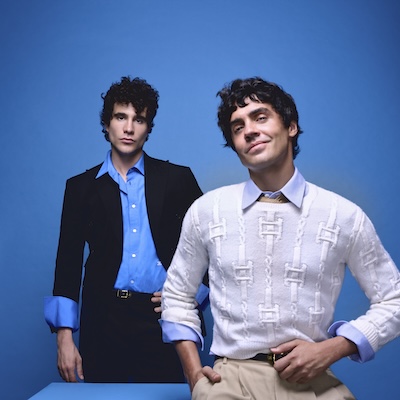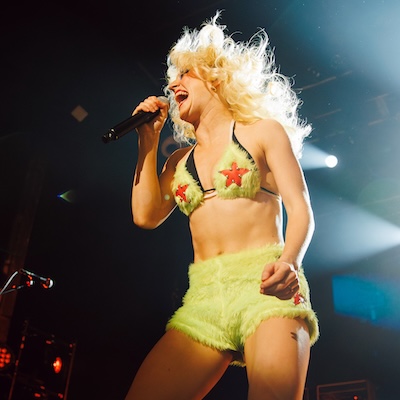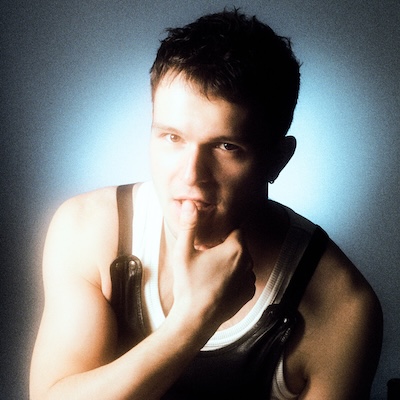
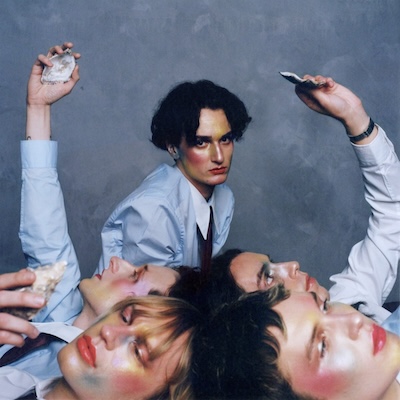
After nearly a decade together, Walt Disco questioned whether they should carry on. Instead, the Glasgow five-piece have made walt disco, a self-titled third album and their first for EMI North. Following Unlearning and The Warping, the record trades some of their earlier electronic and orchestral maximalism for heavier guitars, sharper pop hooks and the physical energy of a band playing together in a room. The anthemic “Lies,” the direct and instinctive “Coup de foudre” and the choir-backed “Don’t Do This Alone” show a group becoming more concise without sacrificing their ambition. Across the album, they confront dysphoria, desire, growing older and the precarious reality of making art in 2026. We caught up with Jocelyn Si, Jack Martin and Charlie Lock to discuss the legacy of Scottish post-punk, artistic worth and why this feels like the album Walt Disco were always meant to make.
Your third album is self-titled, which is something we normally associate with a debut. After questioning the future of the band, did calling it walt disco connect to regrouping and deciding to carry on?
Jocelyn: After those two albums, we kind of knew the band we were supposed to be was probably more of a rock band than either of those sounded like. We all have these tastes in bands and music that weren’t really coming across. So there was a level of uncomfortability with our previous work, and also not knowing if it made sense to carry on. But we felt there was more of an interesting story to tell.
When it came to the third album, we were like, “well, let’s give it a self-title”. It was a very easy way of saying, “No, this is the album we always wanted to make.” It feels a bit like a debut because we feel new. We feel like we’ve done what we should have done, or made the album we were always supposed to make. There wasn’t some concept to the album, really. It was kind of just about us; a lot of it about being young people in a band and the struggles that come from that. We were like, we don’t need to give it some big meta title or anything like that.
Scottish groups like the Associates and Orange Juice come up in descriptions of Walt Disco. Do you feel connected to that tradition of eccentric, ambitious Scottish post-punk?
Jocelyn: When we were forming, it wasn’t a reason why we formed, but as we started making music there were people in Scotland telling us we sounded like them—more so the Associates. Then Orange Juice became somewhat of an influence. But on this album we kind of left the ’80s influences behind a bit. People will probably still tell us it sounds like it, because I think there’s a part of us that just has that in us. But it wasn’t helpful, in many ways, for us to be harking back to the ’80s. It kind of confused us a bit.
Jack: I think we saw our music as a lot of different things, but one thing we never deliberately tried to reference was that kind of ’80s sound. We were confused whenever people were like, “Oh yeah, it’s glam rock,” because none of us even like glam rock. A lot of glam rock pure sucks, so we don’t want that to be the sound. But we carry those bands with us in a sense. Scotland has such a rich history of pop music. It’s always been influential and maybe doesn’t always get its flowers for that. We carry parts of the ethos of those bands: there’s a strong sense of melody, being catchy, being ambitious, which is something you’re not always encouraged to be outwardly in Scotland.
“Don’t Do This Alone” features a huge choir of Scottish musicians and creatives. It made me think of Band Aid. If you could take one singer from “Do They Know It’s Christmas?” for the Walt Disco choir, who would you choose?
Jocelyn: I say Bob Dylan.
Jack: I say George Michael, but you could argue whether or not Bob Dylan did in fact sing on that song. He definitely brought a lot of aura to the video.
I thought Bob Dylan was in the American one. I don’t think he’s in the UK one.
Jack: I didn’t realise there were two separate ones.
Charlie: What was it? “We Are the World.”
Jack: “We Are the World” was the Bob Dylan one.
Charlie: Also, definitely George Michael for me. Come on!
He is a good choice.
Charlie: And a dish.

When you were thinking about the live aspect of these songs, what was that translation like for you?
Charlie: I feel like a lot of our band is our live persona. A lot of people in the past have said seeing us live completely altered the way they listen to us on record, so we definitely wanted to capture a bit of that in the recording. A lot of the music on our previous albums has been quite patched together. The end result has been lovely, but we haven’t ever all—or most of us—been in the same room playing together on record. So it’s nice to capture that live element.
Jack: I think in the past we kind of did things in the box. We figured stuff out through demos or in the studio, and then we had to figure out how we were going to do it live. But I feel like it’s the inverse on this record: the way we’d been playing the songs live for a while informed what we wanted to do in the studio. That felt really good, and that energy just translates on the record and on the stage now. Before, when we were making dubstep and orchestral albums, we’d always go into the studio and be like, “How are we going to do this? How can this possibly translate?” The answer is a lot of backing tracks, because we can’t afford to have a ten-piece orchestra with us on stage every night. But not leaning on those so heavily this time—we’re just making a lot of racket ourselves—feels good.
“Lies” feels like an anthem. When you write a song like that, do you immediately sense that it has the potential to become something people will sing back to you?
Jocelyn: We knew we’d written a pop banger. We were like, “Oh, we’ve got this anthemic thing,” but we wrote it without that many guitars on it. It was all synths. It had a sort of *Brat* production on it, or whatever, and Carly Rae Jepsen-like melodies and stuff like that. We were obviously well in the swing of making this rock album, so I in particular struggled to see how it was going to work—probably in a way that was just self-consciousness when you write a pop song. Which is ridiculous, but I always do it.
Jack: Yeah, I guess we always like to think that we’re cooler than that. But we also do want to make big songs that loads of people listen to, so that’s the kind of dichotomy. Usually when we’re all looking at each other and laughing—and we can’t stop laughing at the song—that means it’s quite good. We’ve stepped on something pretty decent.
Charlie: A good cackle is the sign of a good song.
Jack: When we’re running it back and we’re just like, “Fuck off.”
There is a striking simplicity and directness to “Coup de foudre.” Where did that come from?
Jack: I guess it’s because when me and Finlay got together to write the song, we just didn’t have a lot of time. I went out to his, and I had to leave again to go to work in a couple of hours. So it was all just super firing from the hip and not thinking too much, which feeds into the lyrical matter of the song: trusting your instincts, listening to your body, letting the physical override the mental and just doing what you want to do. It’s that self-affirmation of, like, sometimes you know what to do. I guess it’s a big argument for not overthinking.
Tell me about the striking song title “My Body’s Still Mine.”
Jocelyn: I think it’s a big thing of being grateful for what your body gives you. When it’s so easy for everyone to hate their body or wish it was different—obviously, as a trans woman, I have spent a lot of time doing that—I think it’s important to remember what your body can do for you. I don’t think you’re meant to spend your whole life being like, “Oh, I’ve got it all right, so I can’t be sad,” but being grateful for those things is good for you.
Across the record, I kept hearing a theme of knowing your worth. It feels less concerned with reinvention than with continuing to value the person—and the band—you have become. Was that a conscious thread?
Jack: I guess it’s about how this thing you do reflects how you measure your own worth, and how much time you have for everything else in your life that you’re meant to prioritise. Being in a band can make you feel old. Being in a band can also make you feel like you’re falling behind when everyone else has real jobs and are doing the things that you’re meant to be doing by your late twenties—and we’re still doing this thing. Something that we’re trying to work through is that our worth is not—or shouldn’t be—directly tied to this band or art. You should still be enough without it. That’s something I came to realise when I was writing my songs.
Jocelyn: Those songs are kind of still holding our hands through it, because the album’s not out. There’s still a level of uncertainty over whether we make it and can sustain this for a long time. We rehearsed before this and I loved it. I was still really feeling the songs, and I feel like they’re still really helpful to me. That’s a great feeling, especially since they’ve been around for so long: they remain so relevant.
Loverboy takes its name from the Mariah Carey hit. Is there a Mariah song, era or moment that means something to you?
Charlie: Every time she gets taken out of the ice at Christmas.
Jocelyn: I mean, I might have said this last time, but “Emotions.” Especially when she hits that high note.
The whistle tone.
Jocelyn: If someone says Mariah Carey to me, I actually do think of that high note before I think about the Christmas song.
walt disco is released October 2 via EMI North.
Interview by George Alley
Photo: Celia Croft