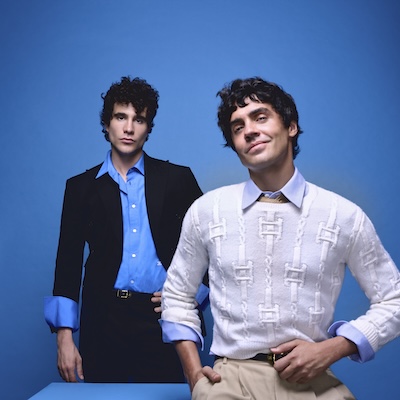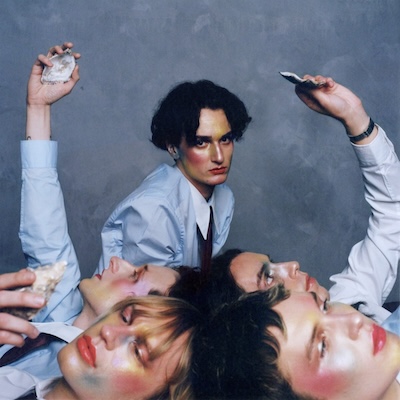
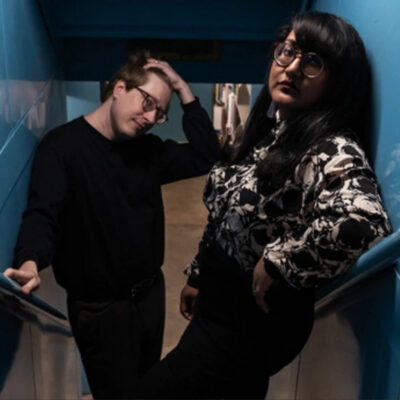
Sweeping Promises return this summer with You Say I Romanticize, their third album and first for Sub Pop. Recorded over eighteen months in Lawrence, Kansas, the record is filled with writers, mystics, outsiders, and characters struggling to find their place in the world. We caught up with vocalist/bassist Lira Mondal and guitarist/producer Caufield Schnug to discuss punk philosophy, literary influences, and why they left Boston for Kansas.
Listening to the album, one thing that really stood out to me was how melodic it is. We don’t often associate punk with melody, but it made me think of bands like Blondie, The Ramones, or some of those early punk bands that embraced harmony. Do you think of punk as a sound, a philosophy, an aesthetic?
Lisa Mondal: That’s such a great question. I think all of the above. I came to punk through post-punk. Television, Wire, The Raincoats, Blondie, Joy Division. Those were foundational texts for me as a teenager. Through the post-punk revival of the 2000s, Interpol and The Strokes brought me to those bands, and then through them I got to Buzzcocks and Sex Pistols, which is what you think of when you think of punk with a capital P. We’ve always been interested in underground musical heritage as inspiration for our own music making. It is definitely a philosophy. We believe in the people power of it and self-expression as the basis, not necessarily genre devotion or adherence. It’s more about songwriting and how we feel in the spontaneity of the songwriting moment.
Caufield Schnug: For me, I was really attracted to punk through the idea of the amateur. I’ve carried that my whole life. It was important to us to make music that people could imagine being able to play. I think recording music in a way that is against idealization is important. The music sounds really material. You can tell how it was made. You can hear the hands that made it.
Lisa Mondal: What I really appreciated about bands like Wire and The Raincoats is that they were able to use melody and weaponize it. You’d have this choral way of presenting vocals while the instruments are falling apart or doing some bizarro alien polyphony underneath. And The Clash too…. “Train in Vain” is such a memorable (pop-like) song and they almost didn’t release it; but I don’t think that punk is anathema to being catchy.
That makes me think of Wire and that kind of minimalism, where you’re not necessarily thinking, “This is where the bridge happens, and this is where the character changes.” It feels like some of those bands were actively resisting traditional emotional payoff.
Lisa Mondal: They are a great example of a band that I think has such a great pop sensibility, but then you listen to especially those first three records, and Colin Newman is just the most acid-spewing pop singer. What I really appreciated about UK post-punk is that they were able to use melody and weaponize it.
Caufield Schnug: I don’t think that punk is opposed to the idea of pop, but I do think there are conceptual lineages in punk that challenge pop catharsis.
Lisa Mondal: It’s funny because for the longest time we were both very much against catharsis in music. We’ve been characterized as writing these kind of anthemic songs for the millennial late-capitalism condition, and what I’ve noticed, especially in these songs as we’ve tried to grow in our songwriting, is that there are these false catharses. Structurally, a song picks up momentum, but at the end you’re left wondering, did anything really change for this person?
The title You Say I Romanticize feels almost confrontational. Was that something you were consciously exploring on this record?
Lisa Mondal: Absolutely. I think every one of the characters or narrators in the songs has some great flaw, and for us that flaw isn’t necessarily a character flaw. It’s this outsider nature that makes them completely unable, whether by choice or circumstance, to adhere to the reality that was prescribed to them. They become these wild-eyed creatures on the margins who are having some sort of spiritual breakthrough, psychotic break, linguistic break, a career foundational rupture, an inability to see themselves in the natural world anymore, or becoming completely and utterly attuned to the natural world and not the social.
Caufield Schnug: Our music is not about being your best self or feeling your best in the best way.
Lisa Mondal: Although I feel my best whenever we’re performing live.
Several songs draw inspiration from literary and historical figures including Mary Shelley and Julian of Norwich. What drew you toward those kinds of characters?
Caufield Schnug: Mary Shelley’s The Last Man is the inspiration for the song “Last Man.” Julian of Norwich is this English mystic with a sort of embattled, erotic view of Christ.
Lisa Mondal: I feel like she’s in the zeitgeist now in a very funny way. I first came across her through a meme on Instagram, and then Caufield did a deep dive. There are so many of these fascinating women mystics. Hildegard of Bingen gets a lot of the credit, but there are all these other figures too.
Caufield Schnug: Wonderful drama.
Lisa Mondal: Just spiritually horny. Or horny for the spirit.
Caufield Schnug: Julian truly stands alone.
Lisa Mondal: A lot of the songs are inspired by solitary figures. People caught between wanting to be wildly independent and wanting to be part of some collective that’s an agent for change. Like a friend of ours that was filming the emergence of fourteen million Mexican free-tailed bats in Texas, and we helped on the shoot. That experience inspired “Abduction on Camera.” It was the feeling of being confronted with a force beyond yourself and wanting to be enveloped by it. It’s about the process of disintegration. How do you become part of something larger than yourself without completely falling apart?
Caufield Schnug: This album features characters who are borderline, quasi-monastic womanly writers going feral in the basement. But that’s also a type of perception.
The band has gone from Cambridge to Austin and now Lawrence, Kansas. How has that transition shaped your work?
Lisa Mondal: Sweeping Promises started in Cambridge in 2019. We were in three other bands at the time and these songs just kind of tripped out of us. We realized they belonged to their own thing. The first record happened in the middle of the pandemic. Then we moved to Austin and started writing Good Living Is Coming for You. This third record is heavily informed by touring and finding ourselves in Lawrence as our permanent home base.
Caufield Schnug: We moved here pretty much in order to live cheaply and do this full-time. We have our own studio in the back. In Cambridge we had a 400-square-foot apartment and one microphone.
Lisa Mondal: We were sneaking into spaces on Harvard’s campus to record ourselves. It felt like this thing wasn’t supposed to happen. Now we’ve transitioned into being full-time artists, and the title You Say I Romanticize is very much connected to that. We live in a world that would have you abandon your art practice in favor of being normal.
A lot of artists feel pushed out of major cities. Did that play a role in your move?
Lisa Mondal: Absolutely. We embraced Boston, but I feel like the city didn’t hug back. So many of our music friends got pushed out. It’s the same story in a lot of major American cities. They’re just too expensive and increasingly unfriendly to artists. We still love city life, but now we can visit it and then retreat and reflect.
Caufield Schnug: We didn’t move to Kansas to slow down. We moved here to speed up. We have a tour house. We record other bands. We couldn’t do that in a city. We would never have that infrastructure or that freedom.
Lisa Mondal: In Boston I was so self-conscious. I couldn’t sing at full volume because people would hear me through the walls. Here there’s freedom. You feel like you’re not supposed to be there. Your presence is a nuisance. Artists in big cities, especially now, are these Cassandra-type characters. You’re saying something and you’re trying to act and you’re trying to build something, and everyone’s just like, “No. You’re crazy. I can’t hear you. You’re not supposed to be here. I don’t like what you’re saying.” And here we can get anonymous.
Has touring changed the way you write songs?
Lisa Mondal: For the first time, the idea of playing songs live had equal weight in our minds. Touring has opened up an entirely new world of musical community and performance for us. But first and foremost it’s still just us in the studio. Caufield playing drums, me playing bass, a microphone nearby in case I’m blessed by the muse of melody. It always starts bare bones.
Caufield Schnug: I try not to think about playing songs live when we’re writing them.
Loverboy is named after the hit Mariah Carey song. Is there a Mariah moment that means something to you?
Lisa Mondal: As soon as you said that, I was immediately transported to Butterfly-era Mariah Carey. I grew up in Arkansas and my mom hosted international students. One year there was a student named Corinna who was kind of like an older sister to me. She showed me the Butterfly album and I became obsessed with it, especially “Honey.” I remember realizing for the first time that all of those vocal layers were her. I tucked that away somewhere in my mind. Later I started singing in choirs, and eventually when we started making records together, especially this one with all the vocal layers, it all goes back to Mariah Carey.
Before we wrap up, is there anything else you’d like to add?
Lisa Mondal: Trans rights are human rights. Free Palestine!
You Say I Romanticize is released August 14 via Sub Pop and they are currently on a North American Tour
Pre-Order Vinyl at SubPop MegaMart
Interview by George Alley