One of the many annual highlights of living in Barcelona is 23rd April, when we celebrate the day of Sant Jordi, the patron saint of Catalonia. He slayed a dragon, saved a princess, and a red cross on a white flag is his emblem. Well, in Catalonia, we don’t just celebrate Saint George — I mean, Sant Jordi — on this day; we also celebrate two rather famous writers, William Shakespeare and Miguel de Cervantes, who are both commemorated on 23rd April. The tradition dictates that men give women red roses and women give men books. The streets of Barcelona are strewn with petals from the reddest of roses, while stalls line the streets, showcasing some of the region’s most significant authors, who spend the day signing books and dedicating them to their readers.
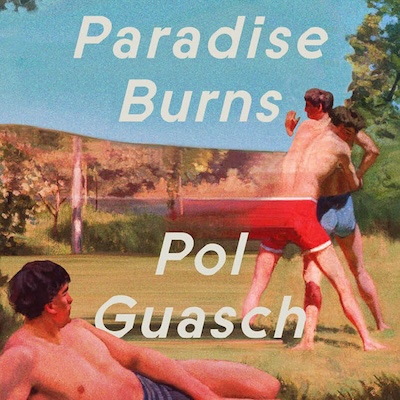
This Sant Jordi, we got in line for Pol Guasch, one of Catalonia’s most exciting contemporary LGBT+ writers. His debut novel Napalm in the Heart has been translated into ten languages and The New Yorker named it as one of their books of the year in 2024. When we joined the queue of admirers this April it became clear just how important he is. People were crying as they met him, hugging him, thanking him for his novels and explaining how they much they meant to them. Now we have read the English translation of Paradise Burns, out Thursday, via Peninsula Press, we understand why…
Set in a dystopian future, or maybe even a parallel-universe past, Paradise Burns follows Rita and Líton, who meet at a party and become best friends. Their friendship is one of the few things allowed to flourish in a world ravaged by drought, floods, fires and destruction. Rita lives at the Colony, high in the mountains, with her father who spends his days digging deep into the near-barren mines. Meanwhile, Líton is enlisted in the Service, joining a group of young men tasked with putting out fires across the surrounding landscape. It is here that he falls for René, but in a world this hostile, compassion comes at a cost. Before long, Líton is developing lesions.
In another author’s hands, a story set in a world this desolate might easily become an apocalyptic doom-scroll. But what makes Paradise Burns so compelling is Pol Guasch’s ability to find tenderness amid the wreckage. For all the drought, floods, fires and decay, this is also a novel about the bonds that make life worth living. The friendship between Líton and Rita, and the romance that develops between Líton and René, bring warmth and moments of genuine happiness to a world seemingly intent on extinguishing both. Guasch understands that the end of the world doesn’t necessarily mean the end of feeling. If anything, it can make those feelings all the more urgent. As one line puts it, “they must have thought their youth made them untouchable.” There is something particularly affecting about that sentiment in a world where youth offers no such protection.
Part of the novel’s appeal lies in the way Guasch chooses to tell this story. Rather than following a straightforward chronology, the narrative moves across different moments in time, gradually revealing the characters and their world in unexpected ways. The perspective shifts, too, moving between individual voices and a wider, more encompassing view, sometimes bringing characters together in pairs or groups. This fluidity gives the novel a different dimension, it also feels fitting for a world in which the familiar structures of life have begun to break down. Nothing feels entirely fixed, whether the landscape, the future or the characters’ understanding of themselves and one another.
Mara Faye Lethem’s English translation deserves recognition here, too. Bringing Guasch’s work into another language requires care with the nuances of a novel that balances such starkness with such intimacy. The tenderness of its relationships is as important as the devastation surrounding them, and both need room to breathe. The result is a translation that allows English-language readers to encounter Guasch’s unsettling, often unexpected world without losing sight of the humanity at its heart.
Colm Tóibín calls the novel “mesmeric and beautiful”, while La Vanguardia has hailed Guasch as “the spokesperson for a generation”. Both descriptions speak to the ambition of a writer interested not simply in imagining a world falling apart, but in asking what remains worth holding on to when it does.
Paradise Burns by Pol Guasch, translated from Catalan by Mara Faye Lethem, published by Peninsula Press is out now (£12.99).