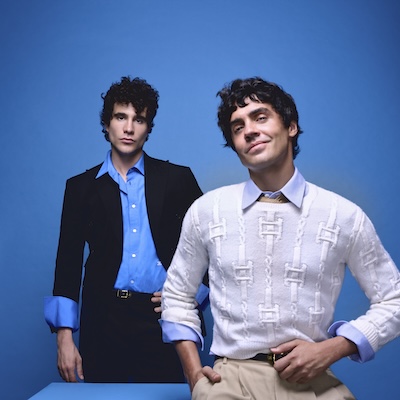
For now, British audiences might be most familiar with Javier Ambrossi and Javier Calvo as the charismatic judges on Drag Race España but that is all about to change after Los Javis won Best Director at this year’s Cannes Film Festival. This is no overnight success either as the duo have been making some of Spain’s most unapologetically queer, maximalist productions for the past decade including 2020’s Veneno about the life of the trans activist Cristina Ortiz.
This week their 2023 award-winning series, La Mesìas, arrives in the UK via MUBI. Selected to screen at both the Sundance and San Sebastian Film Festivals, the seven-parter centres on a deeply religious family ruled by a mother who convinces her children, and herself, that she can communicate with God. She then tasks her five youngest daughters with the simple job of saving the world – through the time-honoured tradition of religion and pop music. What follows is part family drama, part religious nightmare, part musical fever dream, and entirely its own thing.
On the day their upcoming film La Bola Negra is shortlisted as one of three films to potentially represent Spain at the Oscars in 2027, Loverboy speaks with Los Javis about the queer gaze of La Mesías, their love for David Bowie and being able to call Glenn Close ‘mother’.
So, guys, I wanted to know, when seeing the subtitles and the exact words being used for La Mesías in the translation. Has that helped you learn anything more about these characters you’ve created?
Javier Ambrossi: Ah…that’s a very good question.
Javier Calvo: It’s really interesting to watch your own movies, your own shows with subtitles because you can say, ‘That scene was really well written!’ You pay more attention to the words that are written. I think the mother, Montse, says some really nice lines.
JA: It’s crazy because when you see your shows or your movies subtitled, you like them more!
Really?
JA: Yes, because you have the sense that people are going to understand all the words you wrote more. You know, subtitles are sometimes clearer than diaglogue with the sound mix. Sometimes maybe as a creator, you’re like, ‘Oh, I would love that to be said differently.’ But subtitles read in a neutral way. So what you wrote really comes up in a different, a more clear direction. I’m really surprised.
One of the essential themes to your work is always LGBTQ+ characters, but La Mesías is maybe the least LGBT-centred of your projets. How did that change things for you when creating it?
JC: I think this show is really interesting because it has a queer gaze. It may not strictly be a queer show, but it has a queer soul. It doesn’t have queer characters, but the way we look at the mother, the relationship between the siblings, the relationship with art, the need to escape through music, through film, the approach to religion, or even to pop groups. It’s queer. I don’t know why but we, as queer people, like our cults.
JA: It is also about being trapped and that need for freedom. And of course, in the LGBTQ+ community, we all understand what it’s like to feel, at some point, that there is something wrong within you – that you’re trapped and need to escape or you’ll explode! In this show where all the characters in the show are under Montserrat, they are like, ‘I need to leave.’ The need to live. I think that is a very LGBTQ+ thing.
JC: Like with Gus Van Sant in Elephant, right? It’s not a queer movie, but the way he looks at the tragedy, the way he looks at the character, the way the character thinks, the stories he is telling and the way he tells the story, it is queer. It’s in the identity and I think that is more interesting.
Right.
JA: And about Elephant…that blonde hair is queer.
All of the actors you use are always so considered through your connection, your relationship with them or their public image in Spain. Can you tell me about your casting process? How do you feel about losing that nuance in your filmmaking internationally?
JA: Well, casting is really important, because a lot of times, we write with an actress or actor in mind. So really, we had the casting, or even the idea of the casting, on the whiteboard with the first structure of the show. We will have faces of different people that we want to write for. Maybe it’s not going to happen, or maybe we change direction, but we try to write for specific people. So it’s very important. Also, we are very used to working with the same crew, with our family. So we try to do the same with the actors and actresses. We try to develop relationships with them, of love and affection, of trust, because we think it is the best way to to help them. So, yes, now that we are going to grow in different directions, let’s see what happens, but we are ready. We are easy to create relationships with!
Several of your creations have come from real life Spanish figures. Are there any UK figures whose stories you would like to tell?
JC: Of course!
JA: You know my favourite book of all time is Jane Eyre and it really inspired a lot of La Mesías. The revenge, that badass girl, like Irene. There’s something about the way of telling a story that is bigger than life. Like, Jane Eyre, from child to a woman. I’m very connected with those kinds of stories.
JC: You really love that White Teeth writer…
JA: Yes! Zadie Smith is my favourite writer of all time. So, yes, Zadie Smith, and also I think we could do a beautiful movie about David Bowie.
JC: I need to investigate UK figures more but of course Oscar Wilde is like the easiest answer. There’s also something in Christopher Hampton’s play, Total Eclipse, that I really like. I love Rimbaud, Verlaine. It’s a British play but it’s set in Paris. There are some really beautiful plays written in the UK that I would like to explore.
OK, well I also have a story I would like to see you tell. So I’m going to pitch it!
JC: Go for it!
You know here in the UK we love our soap operas with Coronation Street being one of the biggest.
JA: Yes! We know Coronation Street and Eastenders!
Oh! Ok! Well…Coronation Street was created in 1960 by a gay guy called Tony Warren. Tony was totally inspired by everything happening in gay Manchester at that time and so many of the characters in Coronation Street, the strong women especially, were inspired by the drag queens and people he knew from Canal Street. I love him bringing all that queer influence to primetime UK TV every night when being gay was still illegal.
JA: Oh! I will totally investigate that! We are very open to telling stories from around the world now.
Ok, I look forward to hearing from your agent! The fictional group in La Mesías, Stella Maris, performed at Primavera Sound. Did you have some very surprised Brits in the crowd going, ‘What the fuck is happening?’
JC: Yes, they were like, ‘This shit is good! Who is this?!’
JA: At the beginning people were like, ‘What is going on?! Is this a joke?!’ For the first fifteen minutes their jaws were dropping. But at the end, you could see they were dancing and having fun.
How was that day for you? It must have been a shift after the tension in the storyline of La Mesías.
JC: Amazing 10,000 people just raging along!
JA: I think it was even more, Javi. I think 20,000 people. It was crazy. But it was like the end of a moment in Spain, because the show became such a big phenomenon. And it was a very, very big way to close that era for us.
You’re so well admired throughout the industry now. Was there one person in particular who got in touch after seeing La Mesías to congratulate you?
JC: Glenn Close loved it. She sent a letter saying that the images will stay in her soul forever, that we had made a piece of art and that she was profoundly impressed & moved by the programme. How did I answer that?! I wrote, ‘Thank you…mother.’
As you would. Spain is having a real moment right now. You guys are breaking through, Rosalia is getting universal acclaim with Lux, Carlos Alcarraz is winning everything, Spain just won the World Cup, Pedro Sanchez is standing up to Trump, Javier Bardem is talking about Palestine. It really feels like something is happening in Spain. How do you see things internationally?
JC: I’m extremely proud to be part of that moment through cinema, my favourite thing ever. And I love my country, I love my culture. I love those people you mentioned. Rosalía, Penelope, Javier, are good friends of ours. So, yeah, let’s get the world!
Is there anybody else from Spain that we should be keeping an eye on?
JC: There’s Judeline who is singing in La Bola Negra. She just reached Number One on both Apple and Spotify’s Global Songs Charts. She has a song with Karol G.
JA: Yes, Judeline and also Guitarricadelafuente. He is another one to watch.
La Mesías is streaming with Mubi. So I wanted to know which directors on that platform were maybe a draw for you in making this decision.
JC: I’m not sure if Mubi in Spain has the same as the UK but I remember seeing Beau Travail by Claire Denis on Mubi recently. I recommend watching that.
Finally we are named after the biggest-selling song of 2001 so we always ask what is your favourite Mariah Carey song?
JA: Oh my God. I think my favourite is the one that goes, ‘Doo-doo-doo-dow, doo-doo-doo-doo-doo-doo-dow.’ ‘Always Be My Baby’? That is me totally.
JC: Hmmm…I think mine would be ‘My All’. The Spanish version? Exacto.
The first two episodes of La Mesìas are available to stream on MUBI in the UK now.
Episodes will continue to roll out weekly.