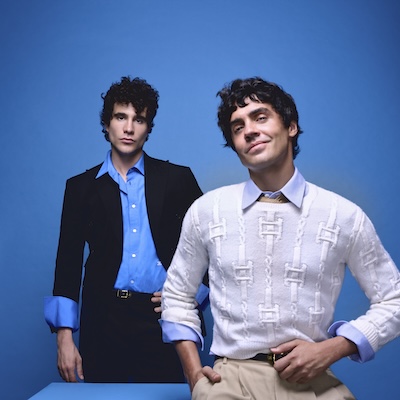
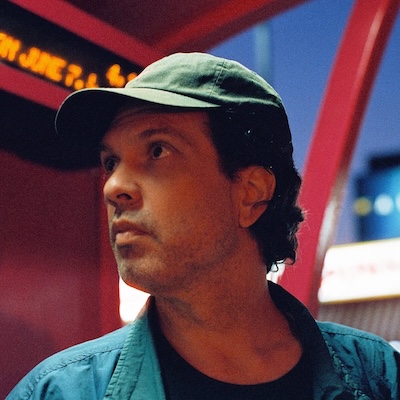
Black Marble returns this summer with Life in Small Spaces, Chris Stewart’s latest album under the long-running project, released via Sacred Bones Records. Trading some of the project’s familiar walls of synths for staccato guitars and live drum samples, the album features immediate songs about the sacrifices involved in choosing a creative life.
Loverboy caught up with Stewart to discuss the changing nature of indie, the pressure on musicians to become influencers, and why two radio stations can briefly combine to create a cool third song.
The cover of Life in Small Spaces places you in a sparse white room, but you’re surrounded by an explosion of confetti. It made me think about the album’s idea of limitation as a kind of freedom.
I think the confetti and all that stuff is metaphorically the life and colour that you can have in a creative life if you choose it wholeheartedly. But at the same time, being in this bed and in this kind of stoic space, the life of a working, “blue-collar” artist can be difficult. I read something somewhere where it’s like, as an artist, you can have friends and your art but no money; you can have money and your art but no friends. There are trade-offs in life, and there certainly are when you choose a creative life. I felt like that was important to talk about. That’s where the white room with nothing in it comes from: talking about these sacrifices that you just have to make.
In music, a lot of times you’re encouraged, not explicitly but maybe implicitly, to talk about things that seem dangerous and sexy, because in the back of your mind you’re thinking, “This is what sells. I need to talk about themes that are visceral to people.” But often I feel like that’s at odds with the tenor and tone of the life you choose when you’re a working artist. There’s something almost more monk-like about it.
There is still a hangover from the twentieth century in how musicians are expected to present themselves: removed, mysterious and sexy. But the industry no longer allows many musicians to make the living that helped create that mystique. How do you see that tension now?
Before, you were buying the person, buying the music, and now you’re renting the person. In terms of social media, I get told by my label all the time that I have to post more, that I have to post on TikTok. It’s like, well, that’s kind of an influencer, and I feel like that’s a different job. But technology has made it so that’s now the job. I never wanted to be an influencer. I never wanted to pretend my inherent existence is something that everyone needs to pay attention to. I’m one of those more old-school-minded artists where I wanted the music to speak.
The problem is there just isn’t any money. Maybe if you’re on a major and say, “Here’s my media plan. I want to make fifteen little pieces that tell a story about the record,” they’ll give you a budget. Below that, in the indie world, it’s like, “Yeah dude, that’s nice. Thanks for the media plan, but why don’t you go on TikTok and say, ‘Hey guys, what’s your favourite song? Take the poll,’ because that’s free?” Then you’re an influencer.
You emerged from a very social New York music scene in the early 2010s. Has your idea of what constitutes a scene changed since then?
I think that whole world still exists. There’s a world of majors, a world of indies and a world of local scenes. What has changed is that, on the indie level, those people used to know each other. Nowadays, if your typical indie label has seven active touring artists, none of them know each other. They might not live in the same country, and they definitely don’t live in the same city.
But these capitalist institutions can’t own all music. Local scenes will necessarily always exist, even if they’re only a springboard. There are strong underground punk scenes in all these places you might consider second-tier cities, and that feels the same to me as it did fifteen or twenty years ago.
How do you take those ideas about the realities of being a musician and translate them into songs?
The songs I write have different themes, but the wrapper is the album name and album theme. The songs themselves don’t necessarily speak to those greater themes in a step-by-step process, because then it would almost be a concept album. I trust that if these are the broader things I’m thinking about, there will be a connection between the specific themes a song is telling me to write about and the things I’m talking about in general.
That’s newer for me. When I first started making albums, I was just trying to figure out if I could write ten songs. I wasn’t concerned about any of that stuff. I also come from a world where you don’t want to be caught being too overt about your themes. The album art was as confusing as possible, and the name was something that was supposed to cause more confusion. I wasn’t trying to be clear about any overarching themes. Somewhere along the way, I felt like I should take a stab at being more artistically coherent. For this album, I thought about the themes and the artwork after I had written the songs, but trusted that the songs would echo those themes because they really are the things I’ve been chewing on for the last two or three years.
The press release describes the album as sounding like a radio dial caught between two stations. Was that something you were intentionally pursuing in the production?
People who aren’t creative sometimes think creative people get an idea of exactly what they want, rush to the piano and recreate what came into their head. On occasion that will happen, but typically that’s not how it works. For me, I’m writing a little bit and then trying to find what’s in there of value. Everything I’m doing is kind of like a fog, and I’m trying to creep through it and pull out the pieces that are good, because most of it is bad.
I don’t know if you’ve ever had an experience where you’re driving between two stations and one is going out as the other is coming in. For a second, they almost sync up to create a third song. That’s what’s happening sometimes when I’m writing. I’ll have fifty different tracks and I’m turning them on and off, trying to find a combination where it creates this thing and I think, “That’s what I’m keeping. Now delete all this other shit. Now repeat that for eight bars.” It’s not like I’m having an idea and then doing it. I’m layering a bunch of stuff and trying to find the good in it. I’m almost like a sidecar to my own process.
The album places less emphasis on synthesisers and more on those sharp, staccato guitars. Songs such as “Anything” and “Get Back Up” also feel quite dance-oriented. What led you in that direction?
As you go along, you learn more things technically. As I’ve got better at certain instruments, I’ve wanted to explore them in songs more. That’s partly what happened with guitar. I also felt like having more of those stabby guitars would allow for more upbeat songs. A lot of times an album is a reaction against your last album. In retrospect, I felt my last one had an awful lot of mid-tempo songs, so I wanted to have some more upbeat tracks on this one. I thought that staccato guitar feel would lend itself to more energy.
“Get Back Up” has a counterpoint hi-hat that’s very techno-influenced, although it’s actually a steel pipe. I definitely wanted more energy, and the songs are shorter. There are a lot of three-minute, three-minute-twenty songs on this record. I wanted it to be more bite-sized and digestible. Dare I say, a little poppier.
I think your vocals remain dreamlike. You might not immediately understand every lyric, which encourages you to go back and listen again. How do you think about intelligibility?
I’m always wrestling with that. There’s this artistic conceit of denial of access, and how much that can be a tool in your work or something that strengthens its appeal. I always took a lot of care with what I was saying, but sometimes I thought it would be interesting if you couldn’t really understand it, even though what I was saying was important to me. I was like, “All right, now I will smear this so that no one else will ever know it.” As I’ve gone on, I’ve gone back and forth because sometimes it sounds better to hear the vocal. If you have an uptempo song, it can sound better to hear the cadence a little more. If it’s too underwater, you don’t get the percussive nature of the vocal.
There’s also an element where the vocal is really you. With the other elements you can don the costume of the guitar or the drums, but the vocal is just you talking. If you don’t like the sound of your own voice, there’s the question of how to get across the information you want while creating a character or voice within the production that makes you comfortable with how you’re saying it.
Sometimes I write the sound of the vocal first and then create lyrics that fit that sound. You’re saying gibberish, but it has the right vowel and mouth sounds. Then you go back and ask, “What lyrics actually sound like this gibberish?”
I just watched Billy Joel talk about this in an interview with Rick Beato. He was talking about different vowels having different emotions. You can’t replace an “O” with an “ah.”
Really? Billy is dropping science right now. I wondered if anybody else thought that way. You really cannot. If you write a gibberish lyric where the end of the line is an “O” sound, I will get stuck sometimes because the perfect thing to say ends with an “ah” sound, but it doesn’t work with the melody and the song. You have to pick a lyric that maybe doesn’t work as well in terms of the logic of it, but works better in terms of the emotion, vis-à-vis those vowel sounds.
Loverboy is named after the Mariah Carey song, and every interview eventually comes back to Mariah. Is there a Mariah song, remix, era or moment that means something to you?
I’ve covered a Mariah Carey song, so that’s an obvious one, but I want to talk about something else. There’s her cover of “I’ll Be There,” where she sings with Trey Lorenz on MTV Unplugged. From what I hear, and I don’t know obviously, but from everything I’ve read and heard about Mariah Carey, I feel like she wouldn’t enjoy being upstaged by another singer doing a duet with her. I always thought this duet was this funny thing where every run Mariah would do, he would do it even more. She’s on MTV in front of an audience, so she can’t say, “Hey, dial it back, buddy.” There’s even a moment where she says, “Sing, Trey, sing,” but you can tell she wants to kill him.
Life in Small Spaces is released August 21 via Sacred Bones Records. Pre-order it here.
Black Marble begins a North American tour on August 22. Dates and tickets here.
Photography by Ashley Leahy.
Interview by George Alley.