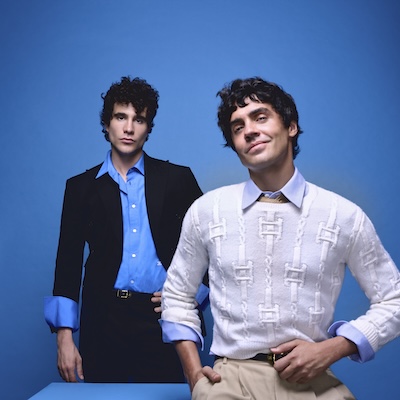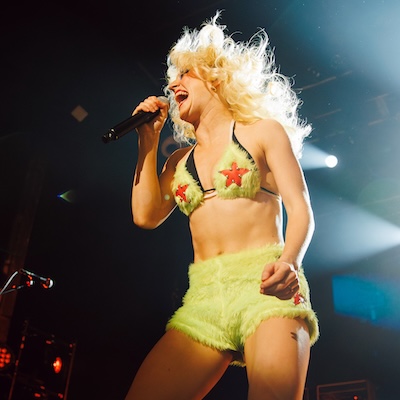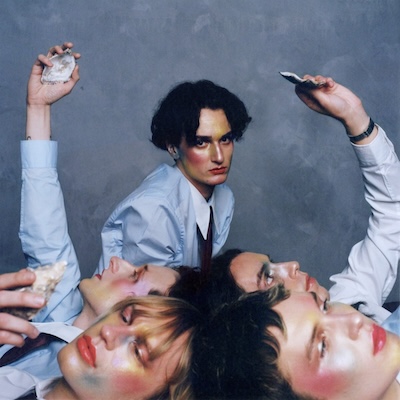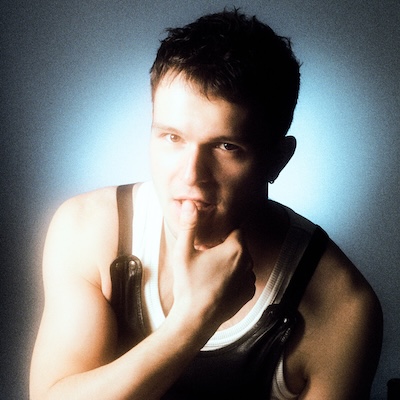
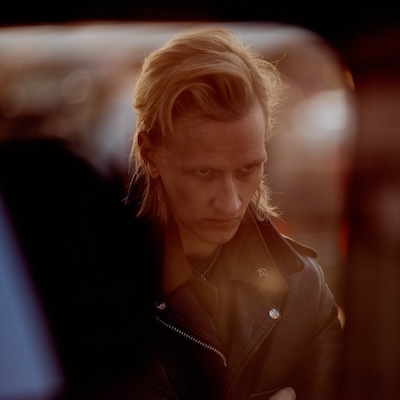
Spike F*ck describes evidence as a physical, carnal experience. Before making it, he shelved another planned debut, Pure O, after spending two years working on it. The record that emerged instead took just three months to write and record, with the artist behind Smackwave (2016) embracing spontaneity. Spike calls it “synthetic rock and roll” it is a collision of drum-machines, new-wave sheen, Elvis, glam swagger and the unruly spirit of proto-punk. Working with producer Adam Hyde, aka Keli Holiday, the sounds feel very immediate, like the exhilaration and danger of a first rock show. Moving through it all is a vagabond who might have wandered out of a Jean Genet novel, by turns defiant, vulnerable and funny, still untangling his own confessions.
We spoke about Pere Ubu, the performance of being respectable, making music out of desire and desperation, and spending a birthday at Staples.
There’s been a big gap between recorded releases. Did evidence feel like a proof of life? What was your approach to this album?
I released Smackwave at a time that I was very young and naive, and it was a spontaneous thing. It was received better than I could have ever imagined and has become a sort of cult classic. When you have a bit of motion when you’re young, you want to follow it up with something that isn’t horribly self-serious or sophomoric. I wanted it to live up to the hype. And I just became scared.
So, I had made a record that was all the things I didn’t want it to be. I spent two years making it and a bunch of money. I shelved it and made this one instead. And I’m very proud of it. I think it’s a physical, carnal experience for me. Libidinal, you might say. We did it on Bondi Beach. It was sun and sand and surf. It was not an intellectual process at all. It was just a fun exercise in pure expression.
Is your writing process more about working songs out in performance, or being in the studio creating a sound and tinkering with plugins and effects?
I’m technologically, technically illiterate. I think I know what a plugin is! This record was like: I write a song in a day, and the main bulk of it becomes the final master, with some little things on top. But the songs were the songs when I felt them. A feeling of dread or rage or whatever it is, and I expressed it. I want to return to it, but I don’t want to, in a contrived way, try to present it. If I’m singing a sad song, and I’m sad at the time, that’s great. But I don’t do it because I like the affectation, the look of authenticity. It will bore me and frustrate me and enrage me if I have to trot out the same old tired act all the time.
So the songs as they are on the record are one way. I call it synthetic rock and roll. It’s all drum machines. The producer Adam is an EDM guy—he’s in this famous EDM group called Peking Duk—and he was able to make this almost pornographic in its extremes. It’s poppy and slick, and it’s pushed. I wanted to capture what it’s like as a young kid to walk into a rock and roll show and have that experience of: this is exhilarating, but it’s dangerous as well. It’s kind of scary. The live performance, I’m not sure what that will be. But I do know that it’s an evolving thing that is independent of the record.
You have mentioned Pere Ubu as an influence. I’m from Cleveland, where they’re from. Was it their sound or their strange version of punk that interested you?
Like many people, I found The Modern Dance first, and “Street Waves.” Then I discovered Cloudland. I’m like, “Oh, well, how do you explain this?” Them playing on Letterman, and this is pretty accessible, still pretty intelligent, articulate, good music.
I’ve had many phases and many looks. Some might see it as I just have no principles. But I guess I’m just interested in transformation. Taking the spirit of a thing and not being bound by three chords or a certain expression of what it means to be alternative or punk—and looking at the context you’re in: “What am I responding to? What elements am I really, truly subverting?” I’m interested in subversion in a true sense, not simply what it was in the late twentieth century. We all know that it’s in Hot Topic. We get it. What is it now that is truly revolutionary, truly subversive?
Pere Ubu, the sound is crazy to begin with, and the performances looked crazy. But underpinning it all was what I see as a pretty well-thought-out conceptual framework. Are you a big fan?
I do love Pere Ubu, yeah. Peter Murphy covering “Final Solution” led me into them. And then I realized, “Oh, they’re from where I’m from.”
Does the sensibility speak to something in your experience? Is there something about Cleveland that’s…?
Yeah. There was economic decline, this industrial wasteland, and people making music in that environment and responding to it. With Pere Ubu, there’s a sonic element of the industrial.
Melbourne and Australia broadly is like a big suburb. Maybe there’s something about that that connects us. You feel like you’re on the edge of the world. Even in America, if you’re not in those major cities, maybe you feel like you’re absolutely by the wayside.
Yes I see that. New York City felt a thousand miles away when I was in high school because I’d never been until I went to college.
I really love the Times Square of the seventies. Anybody in their right mind would have to prefer the seedy, dirty cinemas—versus the Starbucks or the Apple Store.
Yes! I got to catch the end of the nineties in New York.
Yeah, really?
Yeah, but it was more the club scene and the club kids. That felt kind of edgy at the time.
I bet. Did you come across—was it Michael Alig?
I interviewed him once before he died.
Oh, really? How was that?
I was nervous because I’d never interviewed a confessed murderer. So I got really drunk to do the interview. Then I invited him to a party at my friend’s house, and they were so mad. But he was still on house arrest, so he couldn’t come anyway.
So you hit it off!
That version of me did! I wanted to come back to this idea of subversion. How does that work in your own music? At the beginning of “All by Myself,” you’re talking about a soldier that was killed. Is looking through the past and doing these character studies part of your approach?
I think it’s a bit of obfuscation and ducking and weaving, staying out of culture, in a sense. I’m not trying to be an ambassador for anything. What does work is if you provoke a reaction in someone, maybe negative, maybe good, to get them to feel something and then come to their own conclusion.
I spent a couple of years on my own and deleted social media, deleted everything, pretty much got away from all of my previous friends and just didn’t speak to anyone. I felt like I was in drag for a few years. I was trying to be this upstanding citizen that would dress in this corporate casual way. It was a fairly delusional mind space, but I was getting off drugs, and I was like, “I’ve got to get rid of everything that’s not absolutely necessary to my survival, and I’m going to be invisible. I’m a ghost. No one’s going to look at me. I’m going to work this job in an office.” The craft is one thing, but the music is merely a vehicle for making my life in this world bearable.
It made me think of Jean Genet. These characters throughout history—the dandy, the homosexual—who disrupt society. It feels like that’s what you’re playing with in the palette of this work.
I think so. I don’t know why I’m talking about an English war criminal exactly. It seems rather arcane, but there’s something here that I need to explore, and I’m going to do it because it’s for art. I believe in the power of art, at least for my own life. That’s probably the most idealistic or utopian thing I’ll say: art has the power to transform more than anything in this world, I think. God, listen to me. But it’s true, I think.
You’ve talked about being an unreliable narrator. Smackwave explored addiction and gender. Are those themes you’re still playing with? “All by Myself” certainly has a tension between the music and the lyrics.
Back then I was playing with those themes, and it felt like more fun. The power that you can get from adopting a persona and then bringing that into your real life, and pushing and pushing and pushing—there’s certainly a great strength in that, and it’s fun and exhilarating. But now it’s something that more haunts me.
I still feel very conflicted about gender. I still am dogged by addiction, both the things that happened in my past and the consequences of my active use of heroin, but also the knowledge I have now about addiction and how my brain works differently to maybe others. I have to be really on guard against things that other people might take for granted, like social media, booze or other things.
I’m in my thirties now, so it’s not this “anything’s up for grabs and anything’s possible.” I feel like I’ve got this limited amount of time. For the first time, I don’t want to die. I want to live, and I don’t have enough time. So I have to just go in and take everything with both my hands and just run. It’s this feeling of desperation. It’s very strange to be alive. That’s all I’ll say. There’s no solution to being alive that I know of.
You’ve said you hope the record and videos raise more questions than they answer. What questions would you be happiest for someone to be left with?
Who is this person? I don’t know why I did this, but it’s a diary. It’s basically my diary, or my documents, I describe it as. It is so revealing. Someone has to know what’s wrong with me. Someone out there, tell me what’s going on here, because I have some questions for you.
We’ll leave a comment box in the interview.
Yeah, anonymous.
Well, Loverboy is named after the Mariah Carey song. Is there a moment of her long career that intrigues you?
Long, yes, a long, illustrious career. Obviously, musician, singer. We share that in common. Actor, I believe.
Glitter…WiseGirls.
More to the point, what is your favourite?
Her debut album inspired my debut album in terms of the typography.
Really? Okay. What was the typography?
She had her name evenly spaced above the album. I thought it was so iconic for a debut that I would do the same thing.
[Looking at my album cover] It’s an incredible cover.
What inspired the album cover for evidence?
I got a US O-1 visa, surprisingly. It’s crazy because I’m an ex-drug addict, and I had to say that I was. They sent me off for a medical, and they tested me for tuberculosis and syphilis and checked me for gang tattoos. Then I got this great photo, and I was like, “Well, do something with this.” And I just fried it. I spent my birthday in LA at the—what do you call it? That printing shop? Starts with S?
Staples.
Oh, yeah. Spent it photocopying, scanning, photocopying, printing this thing. Everybody told me it was ugly and I should have not done it like that. But I wanted it to seem like a creepypasta. I was looking at banned book covers. I want people to pick it up and be unsettled, like a police composite sketch and how they’re weird and slightly uncanny. You could tell me it’s the worst thing you’ve ever seen, or that it’s brilliant, and I would have no idea because I don’t even know what I’m looking at anymore.
I like how lo-fi it is. We’re in such an AI time.
You like it? I don’t know if it adheres to graphic design rules. What I like about your album cover is it speaks before you—its reputation precedes itself. To have stark lettering like that, it’s like, well, this at least takes itself seriously. I was thinking about a photo, but the photo can never live up, I feel like, for me. That can never capture that something.
But that’s my answer about Mariah Carey.
Interview by George Alley
Photography by Dylan Marriott
evidence is out October 2 via Sacred Bones Records.
Pre-order / save
UK tour begins October 29, including London’s The Dome.
Tour dates & tickets