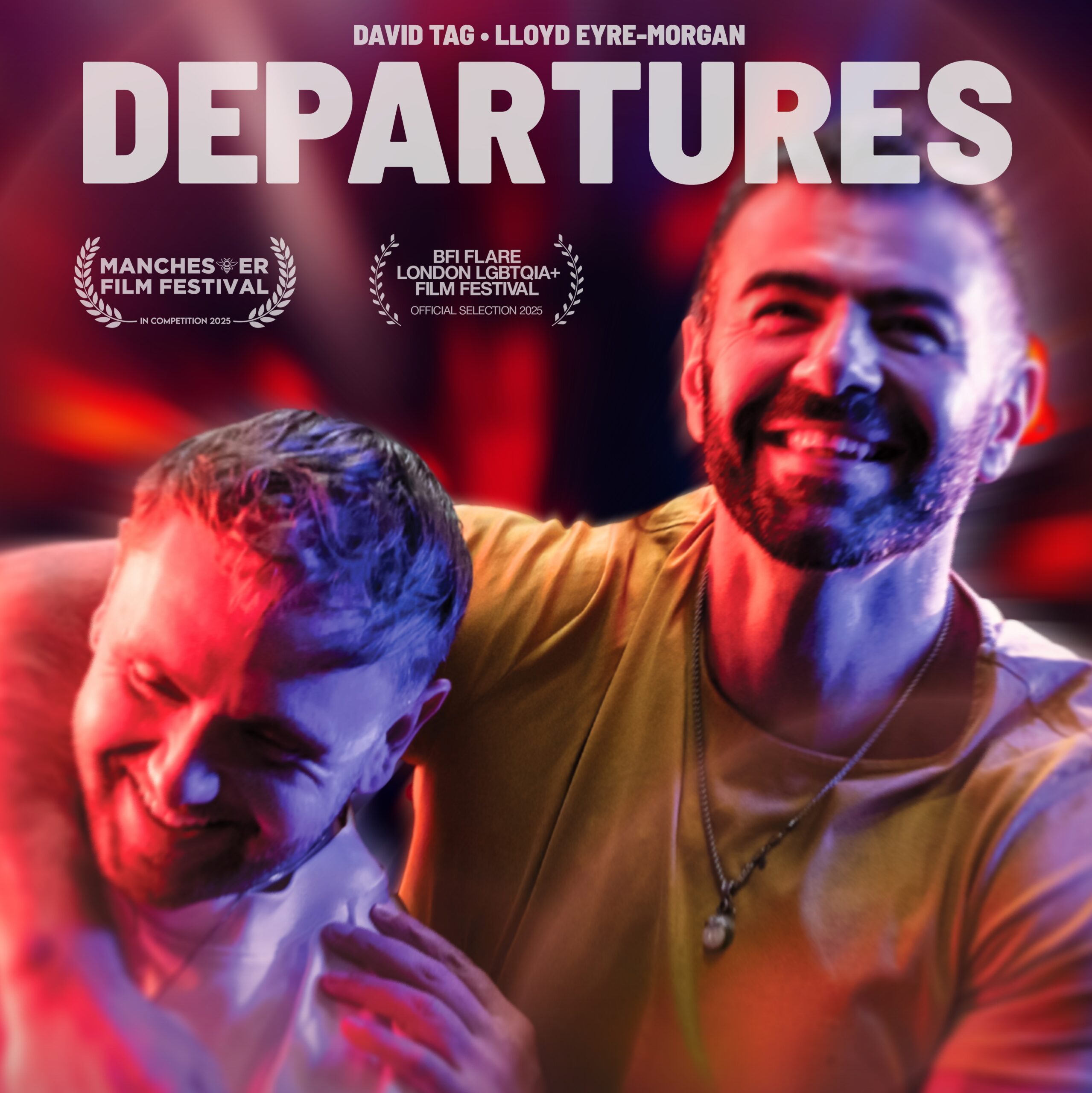
Airports are meant for clean exits and neat arrivals—but Departures has other ideas. What starts with a glance across a departure gate quickly spirals into something far less controlled: a relationship built on stolen weekends, cheap flights, and the kind of chemistry that feels too good to question—until it isn’t.
Lloyd Eyre-Morgan and Neil Ely’s film slips between rom-com highs and something much messier, charting the often difficult journey of departing a relationship we know isn’t right for us and weathering the all too often turbulence that follows it.
For Loverboy, we caught up with Lloyd and Neil to talk about turning real-life chaos into cinema, finding humour in toxicity, and why the most compelling stories are usually the ones that don’t behave.
Departures is out in cinemas this Friday.
Right guys, what’s your favourite thing to do when you first get to an airport?
Lloyd: Have a pint.
Wetherspoons?
Wetherspoons is good.
Ok, last minute borders or glued to the departures board?
Lloyd: I’m that person.
Neil: And I’m the other one. I usually turn up and they tell me I missed my flight.
Airports, flights, layovers, hotels, they seem to have this kind of like sexual queer energy. Did that play any part in your idea to base the movie in these types of areas?
Lloyd: I think the locations for the movie were more about the escapism of going away and, specifically Amsterdam is an escapism destination. You know what happens in Amsterdam stays in Amsterdam. Also, the idea of departing a relationship tied into it. Also it’s kind of a bit of no man’s land, isn’t it, airports?
Neil: Have a pint of lager at, like, 7:30 in the morning.
Yeah. it’s lawless right? At the Airport anything goes.
Neil: Yeah, exactly.
The movie is billed as being based on real life experiences. Does It pull from one of your backgrounds more than the other?
Lloyd: The thing is, me and Neil have been linked the last 13 years so It’s very much sort of an amalgamation of experiences we’ve both had.
Throughout the movie, from the very beginning, Benji seems to be attracted to the unattainable from high school crushes to the protagonist Jake. Is that something that you guys have experienced in your own lives? Is it inherently a gay experience?
Lloyd: I’ve definitely experienced that and I definitely tend to be attracted to people that aren’t boyfriend material. Which I don’t think is uncommon in gay or straight relationships. a lot of straight people have come up to me at the end and said that they related to it and saw themselves in Benji as well
The film has a very distinctive style mixing monologues with onscreen animations which can be quickly followed by sexually explicit scenes. Was that on purpose or is it something that just developed naturally while you were making it?
Lloyd: The cartoons came in later. I felt like it needed it, they are an embodiment of Benji on the screen and links to his dissociation which is part of the larger theme in the film. I just thought it was an interesting layer of storytelling, and I love that kind of storytelling.
With that in mind then, what other filmmakers, either gay or straight, have influenced your style of storytelling?
Lloyd: What do you think, Neil?
Neil: I suppose Queer as Folk, Russell T Davies has always been a big inspiration to us both. I was 15 when it came out and literally everybody in school the next day, gay, straight, whatever, had literally watched Queer as Folk the night before. So all of a sudden everybody just wanted to go to Canal Street. So he’s always been a, a huge inspiration to both of us. We were lucky enough that he came and watched the film and really enjoyed it.
Anything else?
Neil: Um, and then Spice World, the Spice Girls inspire everything that I do. I hope to direct Spice World 2.
Benji’s journey feels linked to validation or self-validation or self-worth. Is that the main story in the film, loving yourself?
Lloyd: Yeah, I think it is. I think it’s about loving yourself and also about letting go and a grieving process of losing somebody whether it’s through a relationship or just losing someone in your life.
There’s some pretty emotionally raw scenes in it. Was it particularly difficult to film any of those? Were there any that you felt like you were pushing it a bit too far?
Lloyd: There’s nothing that I think we felt went too far. I think doing the sexual assault scene was difficult cause it was based on something that actually happened to Neil. I wanted to get that right, we both wanted to make sure that it was done carefully.
Neil: We wanted to make sure that we kind of got it right and originally the musical number at the end was part of the disassociation in that scene because that’s what I did. I disassociated but it didn’t sit right and then Lloyd came up with the idea and said, “how about this?” And we kind of put lots of different shots in and that felt more authentic.
So did it end up feeling cathartic?
Neil: I had years of counselling with a male charity called We Are Survivors. They’re based in Manchester. So with that process and filming the scene, yeah, it felt cathartic.
Throughout the film, we feel a lot of sympathy for Benji. But what about Jake? Are we ever supposed to feel any sympathy for him in the movie?
Lloyd: Yeah. I think we both wanted to make sure that was the case. It’s more complicated than he’s just an asshole. That’s why we wanted to put the flashback in. We decided to put that in quite late into filming. I think we were three months in and we thought “It needs a little bit more exploration of like who he is.” Human beings are complicated.
Neil: It’s just having empathy. I’ve had a relationship that was with somebody who identified as bisexual and had previous relationships with women and, and had children. I understood that they faced different challenges.
The film was self-funded by Manchester creatives right? Did that make you feel braver or more worried when making choices?
Neil: Well it was funded by Lloyd, Myself, and Paul. Then there was a lot of investment as in people lending us equipment or giving us their time.
Lloyd: You painted and decorated as well, so we could get lighting equipment, didn’t you?
Neil: Yeah, I did a lot of favours for this film and did things like making curry every Friday for the cast.

But do you feel like it gave you more freedom?
Neil: Well, it’s kind of catch-22 because it gives you freedom so you can make choices and you don’t have somebody who’s put money into it wanting to have their input but on the other side of it, I suppose it limits you because, you know, you’re working all week, earning money to keep a roof over your head, to pay bills like we all do, and then you are a bit like, “Oh, fuck. We don’t have money for this, or we don’t have money for that.”
What do you want people to feel after they have left the cinema? What do you want ’em to take away?
Lloyd: I think that I want people to feel like they’ve been on a journey.
Neil: Like they’ve been on like a crazy holiday.
Like they’ve been on a bender in Amsterdam?
Neil: Exactly and I also want them to feel like they wanna write a nice Letterboxd review.
If you could bump into one of the characters from the film in the departures lounge, which one would you wanna bump into?
Both: Auntie Jackie
My last question is that we are named after the biggest selling single of 2001. So we always ask, what is your favourite Mariah Carey song?
Neil: Uh, my favourite Mariah Carey moment is, I don’t know her and my favourite song is ‘We Belong Together’.
All right. A little bit of a ballad. Okay. Lloyd, do you have any?
Lloyd: I mean, I don’t really know her…so and I’m gonna have to say it’s the Christmas song.
DEPARTURES will be released in UK & Irish cinemas from 17th April.