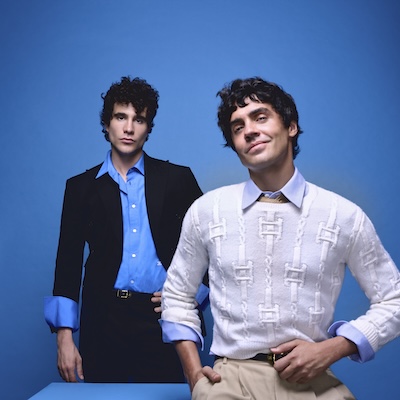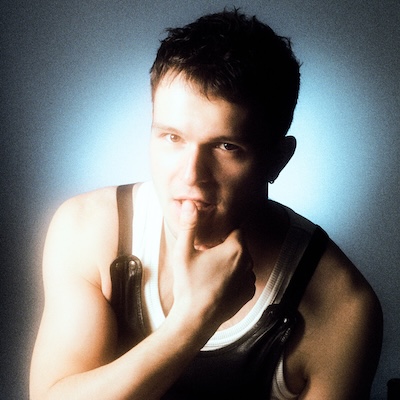
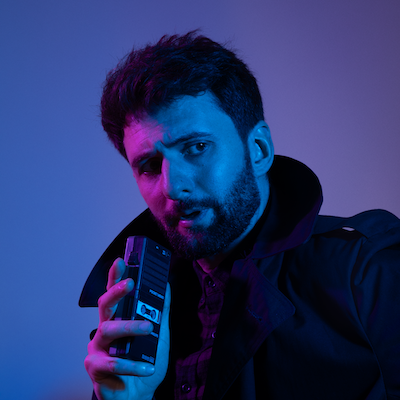
Minute Taker’s new single “Surrender to the Night” was written on a hungover morning after what he calls “a bit of a mad night out.” With sweeping synths and a late-night sax solo, the track explores the pull of nightlife and the comedown that follows, and previews his upcoming album The Oblivion, due March 2026. We caught up with Ben McGarvey, the singer, songwriter and producer behind the project, to talk 80s influence, queer nightlife and sustaining an independent career on his own terms.
You’ve said you wrote Surrender to the Night while hungover. What was going through your head that morning?
I’d had a bit of a mad night out the night before. Normally on hangover days I just sit around feeling sorry for myself, watching TV. But I thought, you know what? Let’s actually try and do something creative. So I wrote about the night before, the exhilaration of it, but also the dread of it being over and having to face your day life again.
The video has this dystopian, retro-futuristic feel. Where did that world come from?
Me and the director, Brett De Vos, really wanted to go for that retro-futuristic vibe, very inspired by Blade Runner, The Lost Boys and The Terminator. The character you see is in the next two videos as well, so it’s a continuous narrative. The look was based a bit on Deckard and Kyle Reese, who I used to have a huge crush on when I was a kid. Still do, actually.
When you were writing The Oblivion, were you already imagining that character and world?
Yeah, definitely. All the songs live in the same nocturnal universe. The videos came about when I was commissioned to do an audio-visual performance at Waterside. I kind of used it as an excuse to make the music videos for the album. I had a folder full of visual ideas, film stills and record covers, most of it very 80s-based, and lots of story fragments. Brett helped shape that into a proper script based on those ideas.
The 80s seem to haunt your work musically and visually. Why does that era resonate so strongly?
I was born in ’81, so I was very young in the 80s. I did not really get into music until around ’93. But I found myself completely drawn to 80s pop. At the time it was very uncool to like that stuff, especially when Britpop took over with Oasis, Blur and Pulp. It was very frowned upon to listen to Pet Shop Boys or Erasure. So I was quite uncool in the 90s because I was obsessed with 80s music. I have always loved that era. I sometimes feel like I was born maybe ten years too late.
With this album and this song, were you using synthesizers from the 80s? How did you capture those analogue sounds we associate with that era?
I use virtual synths. There’s one called Diva that I really like because it captures those 80s sounds. It would be very expensive to buy all the actual analogue synths, and I do not really have the space for racks of them, as much as I would love to. There is just so much available now in terms of virtual instruments.
How do you keep it from becoming a nostalgia act? How do you balance retro influence with something that feels modern?
I try to write from a modern perspective. I also produce the songs in a way that feels retro and contemporary at the same time. I do not want it to sound like something directly lifted from the 80s, but something in that style with a more modern sheen on the production and mixing.
You’ve produced this album independently and built a direct relationship with your audience. How did that shift happen?
I had been making music for many years and working full-time day jobs on the side because I was not really making any money from it, even though I was releasing albums and playing shows. I had a couple of record deals fall away and I felt very disheartened and frustrated. Then I saw an advert for a music course about identifying your target audience and reaching them directly. I decided to test some of the methods before signing up. People started buying my CDs and I thought, oh my God, this actually works. Within about a year I quit my job and started doing music full-time using that direct marketing approach.
Later I set up my own subscription platform called Secret Songs on my website. People pay monthly or yearly and get access to albums that are not available on Spotify, things from my archives, remixes, extended versions and cover versions. Over time that has become my biggest income stream.
Does having that direct communication with listeners via Secret Songs affect you creatively?
When I am writing new material, I do not usually show it online, even to my subscribers. I like to develop things more before I present them to people. I spend quite a long time crafting albums and trying to get them exactly how I want them. When something is closer to being finished, I might share parts of it and it is nice to get that feedback.
The album feels rooted in queer nightlife, that mix of excitement and comedown. What does the night represent for you?
I really wanted to capture that excitement of having a few drinks and going out and seeing where the night takes you. I still get that sometimes when I go out on the gay scene, that excitement of never quite knowing who you will meet or where you will end up, which bars you will be in and which characters you will end up talking to. I find it very exciting.
But there is also that dread of going too far and the comedown and the depression that can follow a big night out. It is that knife-edge between the exhilaration of the night and the dread of it all being over and having to face your day life again. Sometimes the process of actually going there is more exciting than when you get there.
Tell me about the sax solo in “Surrender to the Night.”
Every good 80s-inspired song needs a sax solo, doesn’t it? I had not actually used sax on my songs until this album, and I really thought it would work well with the late-night vibe. I mocked up the part with a really cheesy MIDI sax just to get a feel for how it would go, and then Jesse Molloy, who has played with The Midnight, came in and made it sound good by actually playing it properly. It is just so inherently 80s. You immediately think of Careless Whisper and those kinds of tracks.
What’s next for the album and what can people look out for?
There is another single coming out in a few weeks, which I worked on with Curses, who is another retro-inspired artist I really like. He is a bit more darkwave, so that is what we have done together. Then the album is coming in spring. There are two more music videos following this one as well.
Loverboy Magazine is named after the hit Mariah Carey song, is there a moment from her career that stands out for you?
I absolutely loved her early albums. When I really got into music in 1993 or 1994, Music Box was perhaps even the first CD album I bought. I played it to death and I still think it is a fantastic album. I love those first three albums in particular. I know she has since said it was not entirely what she wanted to do because she was being moulded and was not allowed to express her more R&B ideas, but I related to those records so much when I was a kid and I still really enjoy them. The first album as well, even though it was 1990, still has some proper 80s sounding moments like “Prisoner.”
Minute Taker’s upcoming album ‘The Oblivion’ come out March 2026
Join: ‘Secret Songs’ and get Minute Taker News
Interview by George Alley