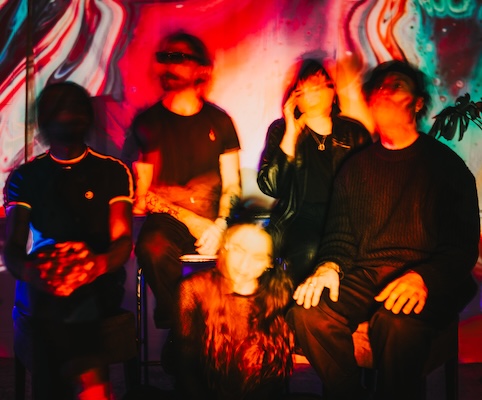
There’s something elusive and slow-burning about the just released Warsaw 480km, the debut LP from PÔT-POT. It’s rooted in grief, dislocation, drone, and a punk-adjacent sonic palette—but never feels too on-the-nose. The textures bloom gradually: harmonium, tremolo, foggy vocals. Even the title comes from a sign seen while carrying a father’s ashes. It’s music that invites you to come closer, rather than announcing itself. The album was recently named Bandcamp’s Album of the Day, and George Alley caught up with the band to find out more…
Your debut album ‘Warsaw 480km’ feels both intimate and aggressive; what was the process of creating the album? Were there mood boards or manifestos that were written? Was there a moment in the process where everything clicked and you felt like, this is the shape of the album?
The album was created over lots of fragmented solo and group writing sessions over the course of a year, while I was traveling around. It definitely started with a feeling of “everything here is too disconnected,” but as we began to play the songs as a band and started recording, that’s when they began to click. I realized we had a cohesive body of work. Mood boards and manifestos didn’t really play a role—it was just pure expression and a desire to make music I would want to listen to myself.
You’ve talked about the songs coming from a kind of transient life space. I’ve always felt there’s something creatively potent (and also kind of unstable) about that; traversing through boundaries between what’s safe and unsafe. Do you think not being rooted helped the writing?
Definitely. The first half of the album was written while I was all over the place. Things settled around the time I wrote the second half. That helped in a practical sense, because I could sit down in one place every day and finish the record. But the spontaneity, the feeling of being unsettled, and the adrenaline of being in a new place all helped spur the writing. It acted as an escape, and in a sense, the settled “home” I needed but didn’t have at the time. It’s funny—now I’m a lot more settled, and the whole time I was traveling I kept thinking, “I just need a base, then I’ll write better.” And now that I have one, I’m thinking, “Hmm, I need to get out there and mix things up a bit.”
I’m drawn to the harmonium, the tremolo guitars, and the way the vocal lines drift in and out. Were those textures there from the beginning?
Yes, this has always been a key feature of our music—even from the early days. We initially had a synth doing drones, though I always felt a disconnect between that digital sound and the organic feel of the drums, bass, and guitar stylings. So bringing in Elaine on harmonium was perfect. It created a new, ever-changing quality to our drone backdrop that’s so essential to the band. Tremolo and harmonium contribute massively to creating rhythmic anomalies in our music, which I feel adds color and novelty to what might otherwise be repetitive grooves or mantras.
You’re based in Lisbon now, but there’s something Irish about the album; perhaps that it makes me think of the mysterious weather I’ve experienced there. Do you see Lisbon in it at all, or does it feel like something you carried with you rather than absorbed?
“Mysterious” is a good word for it! I guess I’m Irish, so that will come across no matter where I make music. But I do see Lisbon in it for sure—these tracks were fleshed out as a band there, recorded there, and performed live for the first time there. I’ll always have that association with these songs. I think I view them as “sunburned” rather than “sun-kissed”—a very Irish identity with a glaze of Portuguese feeling.
The story behind “WRSW”; driving with your father’s ashes, the sign reading “Warsaw 480 KM”. Did that image become something you kept returning to while finishing the album?
Yes, for sure—it still does. That whole song, every single lyric, is about that journey. I remember writing down the name of the album in the car that day. I remember it every time I sing those lyrics. What’s good, though, is that it’s been very cathartic. The repetition has helped reconcile that time and allowed me to create something positive from it.
There’s a kind of spoken/sung quality to the vocals that reminds me of Lou Reed and other proto-punk singers. Do you think of your voice as a character?
I think all our voices have character—I think everyone has character, regardless of having a voice or not! I’ve never been crazy about my voice and still wouldn’t call it my best instrument, but it’s what I was given, so I might as well use it (or cover it up in reverb and delay). The lyrics are important for me to say, so whether I like my voice or not, I have to use it to say the things I want to say.
Genre-wise, you’re hard to pin down (which is a good thing); psych, kraut, outsider pop, drone… What were you listening to while making this that might not be audible, but fed into it anyway?
Lots of funk—James Brown, Curtis Mayfield, etc.—lots of experimental field recording compositions, lots of The Cramps, The Slits, and lots of J Dilla. There are so many things that I feel contributed to this record beyond the classic Velvet Underground, BJM, Neu! influences. Maybe not so much sonically, but definitely in terms of execution and philosophy.
There’s something queer-coded in the way the band presents — not overt, but felt. Is that something you consciously bring into your work; or is it just embedded in how you operate?
I think the only truly intentional things about what we do are playing in time and playing in key (when necessary). Everything else is just us being totally ourselves and learning to be comfortable in our own skin. That’s something that aligns with queerness, but it’s more embedded in us rather than conscious.
What is next for PÔT–POT? How do visuals play into the work of the band?
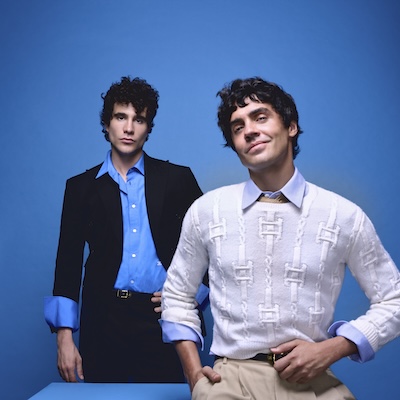
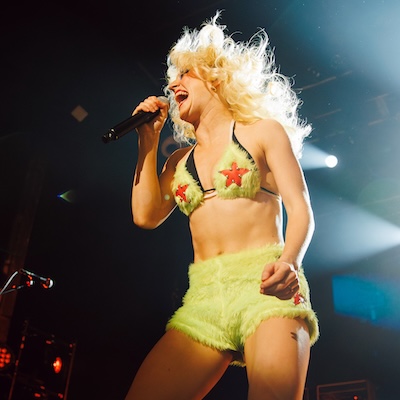
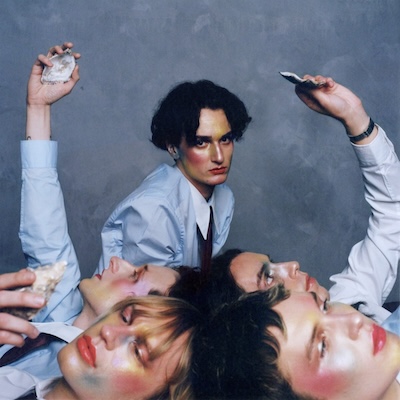
I’m about 20 tracks into writing for Album 2, so that’s what I’ll be spending most of my days figuring out—whittling things down to hopefully around 10. We’ll also be hitting some U.S. and EU dates early next year, which we’re incredibly excited about! Visuals are a huge part of the band—from the uniforms to the album art and videos. I love collaborating with artists I love to create things that reflect the band’s identity. For example, my partner Ingrid made the album artwork, my friend Con did the vinyl layout, and our good friend Louise worked on videos with us.
Finally we are named after the biggest-selling single of 2001 and always ask, what is your favourite Mariah song?
Ooh, favorite song has to be “Fantasy,” but special mention to the remix with Ol’ Dirty Bastard!
Listen to Warsaw 480km by PÔT–POT
Interview by George Alley